
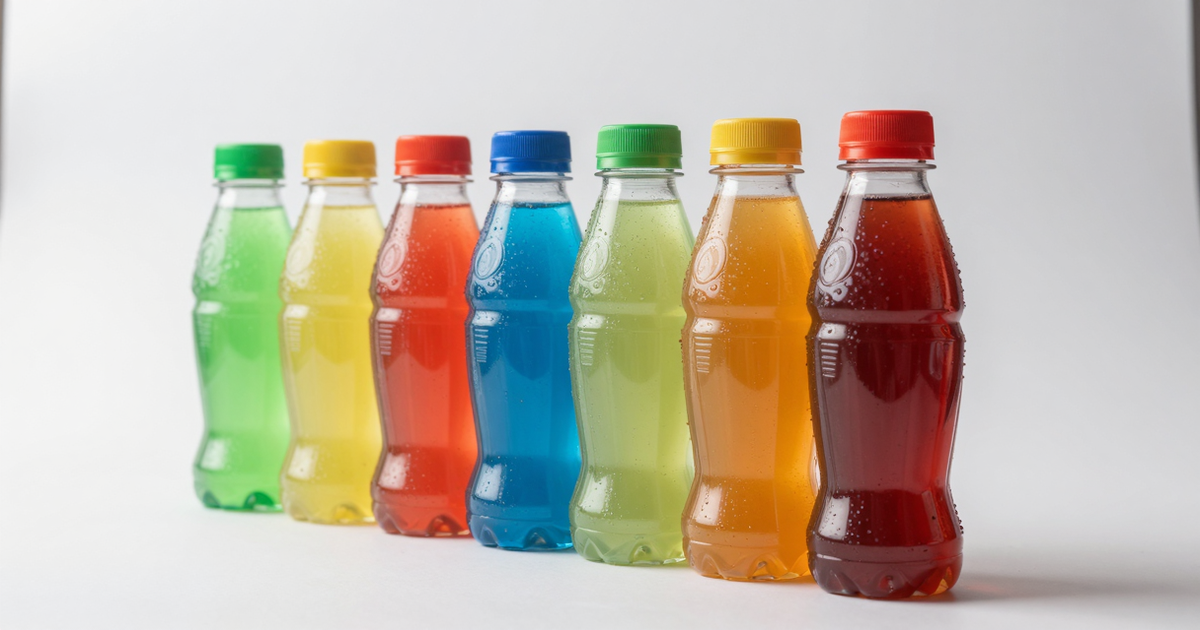
Gatorade is replacing Red 40, Yellow 5, Yellow 6, and Blue 1 with plant-based colorants such as beet juice and turmeric. The rollout is staggered through late 2026. Sugar content is unchanged at roughly 34-36g per 20 oz bottle. Check the back label on each specific bottle to confirm which version you have.
The FDA and HHS Secretary announced that Gatorade is replacing its artificial FD&C colors with plant-based dyes derived from fruits and vegetables. Red 40, Yellow 5, and Blue 1 (the three colorants that have turned sports drinks into Kool-Aid lookalikes for fifty years) are on their way out of the Gatorade bottle.
This isn't a marketing claim. It's a reformulation, and it's worth understanding both what changed and what didn't. If you want the full background on Red 40 specifically, our guide to Red 40 safety and the research behind the EU warning label covers what the dye is and why regulators disagree on it.
Does Gatorade have Red 40?
It depends on which product you pick up. The original Gatorade Thirst Quencher (classic flavors like Fruit Punch) contains Red 40, along with other artificial dyes such as Yellow 5 and Blue 1 depending on the flavor. Gatorade Zero Sugar Thirst Quencher does not list Red 40; it uses vegetable-juice color instead. The newer lower-sugar Gatorade line is also being made without artificial colors. PepsiCo announced in 2025-2026 that it is phasing artificial dyes out across the Gatorade lineup, so the answer is changing fast.
| Product line | Red 40? |
|---|---|
| Original Thirst Quencher (classic flavors) | Yes |
| Gatorade Zero Sugar Thirst Quencher | No (vegetable-juice color) |
| Newer lower-sugar line | No (no artificial colors) |
Check the ingredient list on the specific bottle you have. The front label and the press release are not reliable during a phased reformulation.
What artificial dyes were actually in Gatorade?
The classic Gatorade lineup relied on a small set of FDA-approved synthetic dyes:
- Red 40 (Allura Red AC): the color behind Fruit Punch and Strawberry Lemonade
- Yellow 5 (Tartrazine): the "classic lemon-lime" yellow-green tint
- Yellow 6 (Sunset Yellow): orange variants
- Blue 1 (Brilliant Blue FCF): frost / cool blue flavors
These are petroleum-derived colorants, and they're the same four dyes that show up in about 90% of brightly colored kids' foods in the US. The reason they dominate isn't flavor. It's cost, shelf stability, and color intensity. Plant-based alternatives (beet juice, turmeric, spirulina, anthocyanins from purple carrot) cost 5 to 20 times more and fade under fluorescent supermarket lighting.
So when a Pepsi-owned brand at Gatorade's volume switches to plant-based dyes, two things are happening at once: supply-chain economics shifted enough to make it viable, and regulatory and public pressure shifted enough to make it worth the conversion cost.
Why does this matter for label-readers?
For a parent or consumer who reads ingredient lists, three things change.
First, the ingredient line itself. Instead of "Red 40" or "Yellow 5," you'll start seeing entries like "beet juice concentrate (for color)," "turmeric extract," "spirulina extract," "purple carrot juice," or "fruit and vegetable juice (for color)." These are all plant-derived and generally recognized as safe by the FDA.
Second, the color intensity. Plant-based dyes are softer. The neon-punch red of the old Fruit Punch will look more like a muted pink-red. If you've trained your eye to be suspicious of unnaturally bright foods (a reasonable heuristic), the visual signal itself will improve.
Third, the halo effect. Gatorade is owned by PepsiCo, which also owns Tropicana, Quaker, Lay's, Doritos, Mountain Dew, and about 300 other brands. When a flagship like Gatorade reformulates successfully, the internal case to reformulate siblings gets a lot easier. Watch for similar announcements from adjacent brands in the next 12 to 18 months.
What didn't change
This is the part worth being clear about.
Sugar content didn't change. A 20-ounce bottle of Gatorade still contains about 36 grams of added sugar, which is more than the American Heart Association's full-day recommendation for a child under 18. Dropping the artificial color doesn't make the drink healthier overall. It removes one category of concern (synthetic dye exposure) while leaving another (added sugar) fully intact.
Not every SKU is reformulated yet. The rollout is staggered. Older inventory is still in distribution, and some international markets will lag. If you want to verify, check the ingredient list on the specific bottle in your hand, not the press release.
Sugar-free and sports variants (Gatorade Zero, Endurance formulas) have their own formulations. Some use artificial sweeteners (sucralose, acesulfame potassium) that are a separate discussion, and the dye swap applies to them independently.
What regulatory pressure drove this change?
This announcement arrives against a broader shift. Over the last eighteen months:
- West Virginia banned seven artificial dyes from school food as of August 2025.
- California passed AB 2316 (2024) banning Red 3, Red 40, Yellow 5, Yellow 6, Blue 1, Blue 2, and Green 3 from school food effective 2027.
- Texas passed SB25 (2025) restricting SNAP-eligible sugary drink purchases, which is already visibly affecting retailer shelves.
- EU regulators have required warning labels on foods containing several of these same dyes since 2010 ("may have an adverse effect on activity and attention in children"), and separately banned titanium dioxide (E171) from food in 2022, a decision the FDA has not followed.
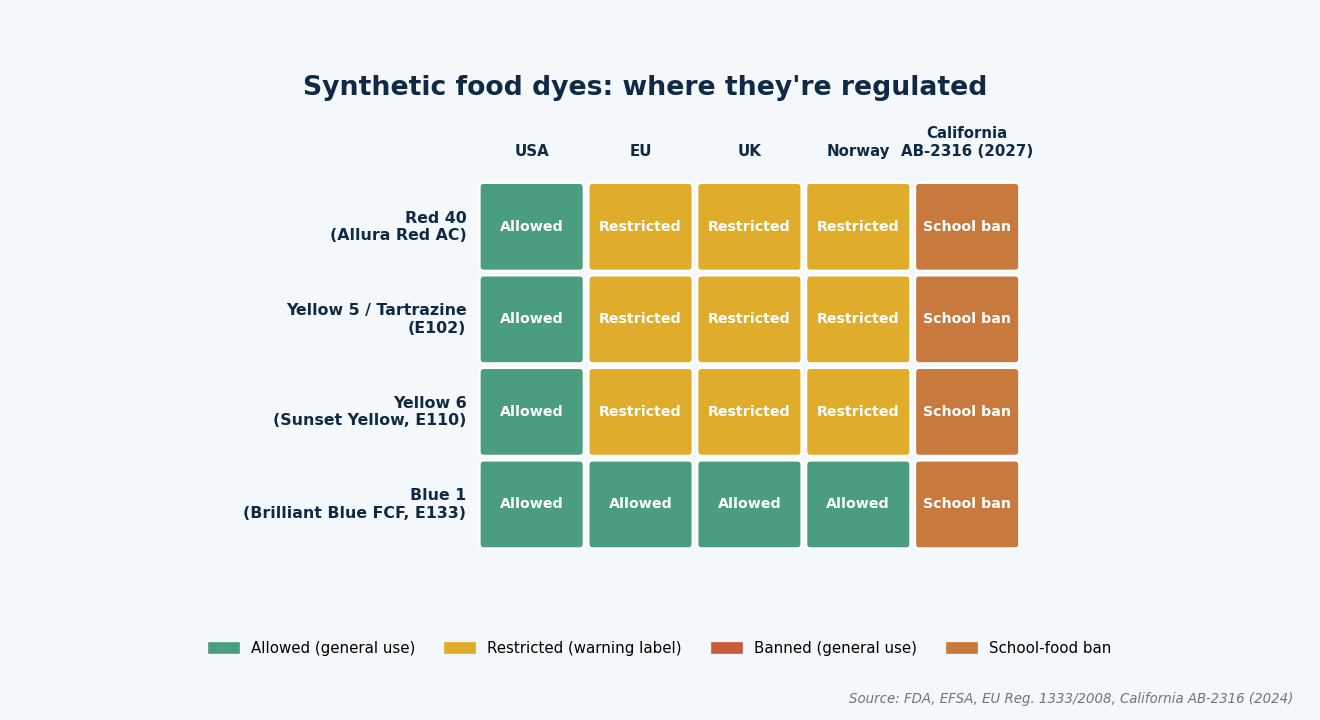
The Gatorade reformulation is the private-sector response to this accumulating regulatory pressure. It's also a preview of where the rest of the aisle is heading. The same products driving concern over food dyes are often the same ones flagged in the NOVA ultra-processed food classification, where artificial colors are one of the defining markers of Group 4 industrial formulations.
How to use this as a label-reader
Three practical takeaways:
- Flip the bottle, always. Don't rely on the front label ("no artificial colors!") when the back label tells you exactly what's in there. Front labels update slowly. Back labels update first.
- Learn the plant-dye aliases. Beet juice, turmeric, spirulina, annatto, paprika extract, and purple carrot concentrate are the common replacements. If you see them, the product used to have synthetic dye or competes with one that does.
- Don't confuse "no dyes" with "healthy." A reformulated Gatorade is still a 36g-sugar beverage. One ingredient change doesn't flip the whole nutrition profile. Use the dye swap as a reason to also check added sugar, sodium, and serving size.
Frequently asked questions
Common questions about this topic.
Is Red 40 actually banned in the EU?
No, Red 40 is not banned in the EU, but foods containing it must carry the "may have an adverse effect on activity and attention in children" warning label under EU Regulation 1333/2008. That warning has driven most major European food brands to reformulate voluntarily. The US has no equivalent warning requirement.
When will reformulated Gatorade hit shelves?
Staggered. Some SKUs are already transitioning. Others will roll out through late 2026. Check the ingredient list on the specific bottle, not the press release or the front label.
Are plant-based dyes actually safer?
They're generally considered lower-risk than petroleum-derived synthetics for the specific concerns raised about FD&C dyes (hyperactivity in sensitive children, potential carcinogen exposure at high doses). They're not a free pass on other nutritional concerns.
What other brands have done the same swap?
Kraft (2016 mac & cheese dye removal), General Mills (Trix, Lucky Charms partial reformulations in 2016), Kellogg's (multiple cereals since 2018), and now Gatorade. The pattern is consistent: pressure builds, regulation follows, then a flagship reformulates, then siblings follow.
Does the reformulation change the sugar content?
No. Gatorade's dye swap only affects color, the sugar, electrolytes, and flavoring system stay the same. Regular Gatorade is still ~34g of sugar per 20 oz bottle. If sugar is the concern, look at G Zero (sucralose, zero calorie) or water.
How do I tell which bottle is reformulated?
Read the ingredient list on the back label. Old: 'Red 40' or 'Yellow 5.' New: plant-based colorant (typically beet juice concentrate, turmeric, or beta-carotene). The front of the bottle is not a reliable signal, the branding stays identical during the transition.
The app reads ingredient labels with your camera and shows you every additive in seconds.
