
Conventional oats are routinely sprayed with glyphosate just before harvest to dry them faster, a practice called pre-harvest desiccation. This leaves residues in finished products. Lab tests have found levels up to 833 ppb in popular oat cereals. The U.S. tolerance limit for oats is 30 ppm; the EU limit is 0.1 ppm. Certified organic oats consistently test at 50-100 times lower residue levels than conventional equivalents.
What glyphosate is
Glyphosate is a broad-spectrum herbicide, the active ingredient in Roundup and dozens of similar products. It kills plants by blocking an enzyme pathway essential to plant growth. Since it was introduced in the 1970s it has become the most widely used herbicide in the world.
When it comes to food, glyphosate is different from most additives and colorings you'd find on a label: it's a residue, not an ingredient. It doesn't get listed anywhere on packaging. Its presence in food is a consequence of how the crop was grown.
The question of how much is safe, and who gets to decide that, is one of the more actively contested issues in food regulation right now. Two major regulatory agencies have reached opposite conclusions about its cancer risk, and a new generation of peer-reviewed research is raising different questions than either side anticipated.
Why oats specifically
This is the part most people don't know. Oats are not a genetically modified crop. There are no commercial GMO oat varieties sold in the US or Canada. So why do oat products test so high for glyphosate?
The answer is a farming practice called pre-harvest desiccation. Roughly one to two weeks before harvest, some farmers spray glyphosate directly on a mature crop to dry it out more uniformly. The herbicide kills the plant, accelerating the drying process. This makes harvesting faster and more consistent, particularly in wet climates where the grain might not dry evenly on its own.
The critical difference between desiccation and ordinary herbicide use is timing. When glyphosate is applied during the growing season to control weeds, the crop has weeks or months before harvest for residues to break down. Pre-harvest desiccation happens with almost no dissipation window. The grain is harvested shortly after spraying, so the residue goes directly into the food supply.
Key point: The Non-GMO label on oat products carries no information about glyphosate exposure. Oats were never GMO to begin with. Pre-harvest desiccation is practiced on conventional non-GMO crops. If you're buying oats specifically to avoid glyphosate, Non-GMO certification is not the right signal.
Oats aren't alone. Wheat, chickpeas, lentils, and flaxseed are also commonly desiccated before harvest, which is why these crops show up frequently in residue testing. But oat-based products have consistently produced some of the highest measured residue levels in consumer lab testing.
What the residue numbers look like
The Environmental Working Group (EWG) ran lab tests on 45 oat-based products and 21 children's cereals in 2018 and 2019, using HPLC-MS/MS methodology. The results were striking:
| Product type | Measured level |
|---|---|
| Honey Nut Cheerios Medley Crunch | 833 ppb |
| Conventional oat cereals (average high end) | 500-1,000 ppb |
| Oat-based granola bars (conventional) | ~400-600 ppb typical |
| Quaker Oats (various products) | ~300-700 ppb |
| Organic oat products | ~5-10 ppb |
EWG's health benchmark for children is 160 ppb. Honey Nut Cheerios Medley Crunch at 833 ppb is more than five times that benchmark. Many of these products are marketed directly to children and are common household staples.
It's worth understanding what the industry's counter-argument is, because it's not frivolous. The USDA Pesticide Data Program consistently finds that 97-99% of domestic samples fall within EPA tolerance limits. The EPA's current maximum residue limit (MRL) for glyphosate in oats is 30 ppm (30,000 ppb). By that standard, even an 833 ppb result is well below the legal limit.
The disagreement is about whether the tolerance limit itself is calibrated correctly. EWG's lawsuit filed in federal court in April 2026 argues that the EPA's oat MRL was raised three times at a single manufacturer's request: from 0.1 ppm in 1993, to 20 ppm in 1997, to 30 ppm in 2008. The EU kept its oat limit at 0.1 ppm. That's a 300-fold difference in what each regulatory system considers acceptable in a bowl of oatmeal.
How the US and EU limits compare
The gap between U.S. and EU standards on glyphosate in oats is one of the starkest examples of transatlantic regulatory divergence on food safety.
| Jurisdiction | Glyphosate MRL for oats |
|---|---|
| United States (EPA) | 30 ppm (30,000 ppb) |
| European Union | 0.1 ppm (100 ppb) |
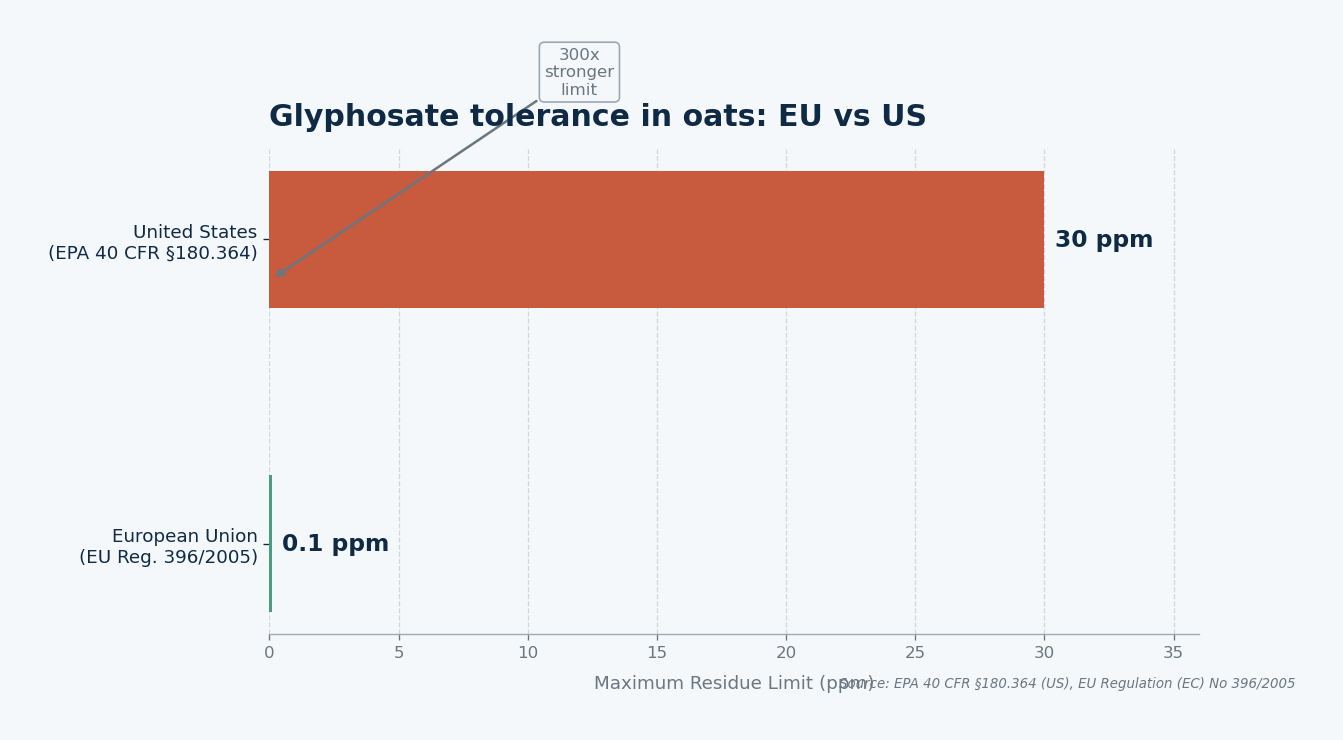
The EU's 0.1 ppm figure is effectively a default "not intentionally used" limit: it's set at the lowest reliably measurable level, which signals that pre-harvest desiccation of food crops is not permitted in European farming practice.
This same pattern appears elsewhere in food regulation, including the EU's 2022 ban on titanium dioxide in food while the FDA still permits it. The two systems weight the same evidence differently, and the burden-of-proof assumptions that drive each approach produce meaningfully different outcomes for what ends up in the food supply.
What the science says about health risk
The cancer question
The International Agency for Research on Cancer (IARC) classified glyphosate as Group 2A, "probably carcinogenic to humans," in 2015. That classification is based on limited human evidence and sufficient animal evidence. IARC Group 2A is the same category as red meat and working as a hairdresser: probable, not confirmed. The classification has not been revised since.
The EPA's position is the opposite: their current stance is that glyphosate is "not likely to be carcinogenic to humans at doses relevant to human health risk assessment." The agency is conducting a full registration re-review expected to conclude in 2026, and is generally expected to maintain its current position.
Two large meta-analyses (reported in 2026) found that people in the highest glyphosate exposure categories have approximately 41% higher risk of non-Hodgkin lymphoma compared to those with the lowest exposure. An important caveat: these studies are drawn from occupational exposure data on farm workers who apply the product regularly. They're not studies of dietary exposure from food consumption. The risk picture for someone eating conventional oat cereal is a separate question from the risk picture for a farm worker who sprays herbicide as part of their job.
One additional development worth noting: a study published in 2000 that was cited as supporting evidence that glyphosate doesn't cause cancer was retracted by its journal in December 2025 due to what the journal described as "serious ethical concerns."
Gut microbiome effects
The more scientifically active area right now isn't cancer. It's the effect of glyphosate on the gut microbiome, and the emerging research here is more consistent than the cancer literature.
A 2024 systematic review (PubMed ID 38994673, PRISMA methodology) found that glyphosate and its formulations "induce intestinal dysbiosis by altering bacterial metabolism and intestinal permeability." A November 2025 paper in Frontiers in Toxicology (doi: 10.3389/ftox.2025.1704231) found that glyphosate exposure reduces the abundance of Lactobacillus, bacteria involved in serotonin production, and induces gut dysbiosis. A study published in PMC (PMC10330715) found that low-dose glyphosate exposure, at levels comparable to the US acceptable daily intake, "can alter gut microbiota composition and modulate the neuro-immune-endocrine system resulting in a pro-inflammatory environment."
None of these studies establish definitive harm at the specific exposure levels a person gets from eating conventional oats. What they document is a plausible mechanism: glyphosate at relevant doses disrupts the gut bacterial community in ways that have broader downstream effects. This is an active research area and the findings are worth tracking.
Where the scientific split sits in 2026: The cancer link at dietary exposure levels is genuinely contested between major regulatory agencies. The gut microbiome effects at low-dose exposure have substantial emerging evidence and are the more scientifically active area. Neither the EPA nor Health Canada classifies glyphosate as a carcinogen; IARC does. None of this is settled.
What children are exposed to specifically
Children eat more food per pound of body weight per day than adults. This makes their relative exposure to any food contaminant higher than an adult eating the same product. Children's cereal products are the category where EWG found the highest residue levels in their 2018/2019 testing.
Products marketed specifically to children, with conventional oats or oat flour as a primary ingredient, represent the highest-exposure scenario. At 833 ppb in Honey Nut Cheerios Medley Crunch, a child eating a daily bowl is getting a consistent, repeated exposure from a single product that exceeds EWG's child-specific benchmark by a factor of five.
The EPA's tolerance of 30 ppm means that product is fully legal. Whether the tolerance is set at the right level is a different question, and one that is currently being litigated in federal court.
What a food label actually tells you about glyphosate
Nothing. Glyphosate won't appear on any ingredient list because it's not an ingredient. It's a residue from the farming process. This is true regardless of how carefully you read the label.
What the label can tell you are things that correlate with lower or higher exposure:
USDA Certified Organic is the most reliable signal for lower glyphosate in grain products. Organic certification prohibits intentional glyphosate use. EWG's testing found organic oat products averaging 5-10 ppb versus 500-1,000 ppb for conventional products in the same study. That's roughly a 50-100 times lower residue level. Trace contamination from drift or shared handling equipment is possible, but organic consistently means much lower, not just marginally lower.
Non-GMO Project Verified tells you nothing about glyphosate in oats. Oats are not a GMO crop, so the certification carries no practical meaning for this specific concern. Conventional non-GMO oats are desiccated with glyphosate at the same rates as any other conventional oat product. The Non-GMO label and the glyphosate question are simply unrelated for oats.
"Natural" carries no regulatory definition in the US that would restrict pesticide residues. A product labeled "natural" can contain conventional oats with full-scale glyphosate desiccation residues.
There's also a third certification worth knowing: the Glyphosate Residue Free certification from the Detox Project. It tests finished products and requires they test below a specific threshold. It's a more direct signal than organic (which certifies the farming practice, not the final residue level), though it's less commonly applied at scale. If you see it on a product, it means the product was independently tested and passed.
NoJunk reads ingredient lists with your camera and surfaces USDA Organic, Non-GMO, and other certification claims on the package. It can't detect residues (no app can), but it can show you clearly whether a product's ingredients are certified organic or conventional, which is the most actionable signal available on a label for glyphosate exposure.

Practical takeaways
You don't need to stop eating oats. You don't need to throw out what's in your pantry. But if you buy oat products regularly, especially for children, there are a few concrete things worth knowing:
- The label "whole grain oats" or "oat flour" without an organic claim means conventional oats, which are routinely desiccated.
- Certified USDA Organic is the label that correlates with consistently lower residue levels, by a large margin.
- "Non-GMO" is irrelevant to this specific question. Don't pay a premium for it expecting lower glyphosate exposure in oats.
- Granola bars and children's cereals with conventional oats as the first ingredient are the higher-exposure products in EWG's testing.
- The Glyphosate Residue Free certification (Detox Project) means the finished product was tested, not just that the farming practice was certified.
The regulatory situation is in motion. A federal lawsuit filed in April 2026 is asking the EPA to respond to a petition it received in 2018 demanding the oat tolerance be cut from 30 ppm to 0.1 ppm, matching the EU standard. The Supreme Court is also considering a case about whether federal law preempts state-level Roundup lawsuits. Neither of those outcomes changes what's on the shelf right now, but they're worth watching if you want to understand where this is headed.
Frequently asked questions
The questions that come up most often about glyphosate and oats.
Why do oats have glyphosate if oats aren't GMO?
Oats are not a GMO crop in the US or Canada. The glyphosate comes from a practice called pre-harvest desiccation: farmers spray herbicide directly on the mature crop 1-2 weeks before harvest to dry it uniformly and speed up the process. Because this happens right before harvest with no dissipation window, residues end up in the grain and in finished products.
How much glyphosate is in oat-based cereals?
EWG lab tests (2018/2019) found glyphosate in the majority of conventional oat products tested. The highest single result was 833 ppb in Honey Nut Cheerios Medley Crunch, which is more than 5 times EWG's health benchmark of 160 ppb for children. Organic oat products tested in the same study averaged 5-10 ppb.
Is glyphosate in oats legal in the US?
Yes. The EPA's current maximum residue limit for glyphosate in oats is 30 ppm (30,000 ppb). Most conventional products test well below that limit. The USDA Pesticide Data Program consistently finds 97-99% of domestic samples within EPA tolerances. The controversy is about whether the tolerance is set at the right level: the EU limit for oats is 0.1 ppm, 300 times lower than the US limit.
Does organic mean glyphosate-free?
Certified USDA Organic means no intentional glyphosate use is permitted. Lab tests consistently show organic oat products at dramatically lower residue levels (roughly 5-10 ppb versus 500-1,000 ppb for conventional in EWG testing). Trace contamination is possible through drift or shared equipment, so organic does not guarantee zero residue. It does mean a meaningful, measurable reduction.
Does Non-GMO Project Verified mean lower glyphosate?
No. Non-GMO verification means the product wasn't made from genetically modified crops. Because oats are not a GMO crop to begin with, the Non-GMO label carries no specific meaning for glyphosate exposure in oats. Pre-harvest desiccation is practiced on conventional non-GMO oats. A Non-GMO label without an organic certification does not signal lower glyphosate residues.
What does the science say about glyphosate health risks?
The picture is genuinely split. IARC classified glyphosate as Group 2A "probably carcinogenic to humans" in 2015. The EPA classifies it as "not likely to be carcinogenic to humans." The cancer link at dietary exposure levels is contested. The more active scientific area is gut microbiome effects: multiple peer-reviewed studies published in 2024-2026 have found glyphosate exposure alters gut bacteria composition at doses relevant to US acceptable daily intake.
The bottom line
Conventional oats are among the most glyphosate-exposed foods in the American diet, not because of GMOs but because of a pre-harvest farming practice that most consumers haven't heard of. The residue levels in popular oat cereals are well within EPA tolerances and far above EU limits. That gap reflects a genuine regulatory disagreement about what level of exposure is acceptable, not a consensus that everything is fine.
The science on health risk is unresolved. The cancer link at dietary levels is contested. The gut microbiome effects at low doses have substantial and growing peer-reviewed support. Neither side of the debate has closed the question.
What's actionable right now: if you buy oats or oat-based products regularly, especially for children, USDA Certified Organic is the label that correlates with dramatically lower residue levels. Non-GMO labeling is not the right signal for this specific concern. That's an honest read of what the label tells you and what it doesn't.